



Short answer: not on her own. Long answer: under the right facts, a Florida judge can, and the process can move faster than most husbands expect. The honest read on this question depends on a few things that are probably true in your situation but worth confirming: whose name is on the home, whether anything has been filed in court yet, whether there are children in the house, and whether your wife is alleging (or threatening to allege) abuse. Those four facts decide the answer. This piece walks through what Florida law actually allows, what it does not, and what husbands should be doing right now if any of this is in motion.
Ownership Doesn’t Decide Who Stays. Florida Law Does.
Whoever’s name is on the deed does not get to lock the other spouse out of the house. Florida treats the residence two married people share as the marital home, and both spouses have a right to live there until a court decides otherwise. That’s true even if the house was yours before the marriage and remained titled in your name only. It’s true even if your wife has not contributed a dollar to the mortgage. Ownership matters when the marital estate is divided at the end of the divorce. It does not give you (or her) the unilateral right to kick the other out today.
The flip side: she can’t kick you out either. Not by changing the locks. Not by calling the police and saying she wants you gone. The only thing that lawfully removes you is a court order. Until there’s one, you stay.
How a Florida Court Can Actually Order You to Leave
Two paths exist. Neither is automatic, but both are real, and one of them moves quickly.
Exclusive Use and Possession (§ 61.071, § 61.13)
When a divorce is filed, either spouse can ask the court for temporary exclusive use of the marital home while the case is pending. Florida Statute § 61.071 authorizes pendente lite alimony (relief during the pendency of the divorce), which the court can shape to include who lives in the residence. When children are involved, § 61.13 governs timesharing and parental responsibility, and where the kids live during the case can drive who stays in the house.
Exclusive use motions are noticed motions: she has to file, you get notice, both sides argue at a hearing. The judge weighs who is the primary parent of any minor children, whether moving the kids would disrupt school or routine, who can afford alternative housing, and the practical realities of two people sharing a home through a contested divorce. There is no presumption that the wife wins this. Fathers regularly stay in the home where they have been the active parent and where moving the kids would cost them stability.
Domestic Violence Injunctions (§ 741.30)
This is the faster path, and the one to take seriously. Florida Statute § 741.30 governs domestic violence injunctions, including the court’s authority to grant a protected party exclusive use of a shared dwelling. A petition for one is filed on Florida Supreme Court Approved Family Law Form 12.980(a), Petition for Injunction for Protection Against Domestic Violence.
If the petition shows an immediate and present danger of domestic violence, the court can issue an ex parte temporary injunction, meaning the order is granted without notice to you and without giving you a chance to respond first. That temporary order is effective for a fixed period not to exceed 15 days, with a full hearing required within that window. At the full hearing, you can appear, contest the facts, and put on a defense. But during those 15 days, you are out of the house, and violating the order (even briefly, even to retrieve your own belongings without an officer escort) is its own problem.
What Happens If You Don’t Comply, and Why That’s a Trap
Once a court order is in place (exclusive use or DV injunction), defying it is the worst move available. Civil contempt is the soft consequence: fines, and in some cases incarceration. The harder consequences are criminal. Entering a residence you’ve been ordered to stay away from can produce trespass or unlawful entry charges depending on the facts. Where the entry is paired with intent to commit another offense inside, prosecutors can charge burglary. Ownership of the home does not immunize you from a burglary charge once a court has barred you from the property.
If a DV injunction is in place, violating it is a separate criminal offense in addition to any other charges that flow from the entry. Re-entering to grab clothes, retrieve a laptop, or “just talk” is the most common way husbands turn a difficult civil situation into a criminal record. Don’t.
Common Scenarios Husbands Run Into
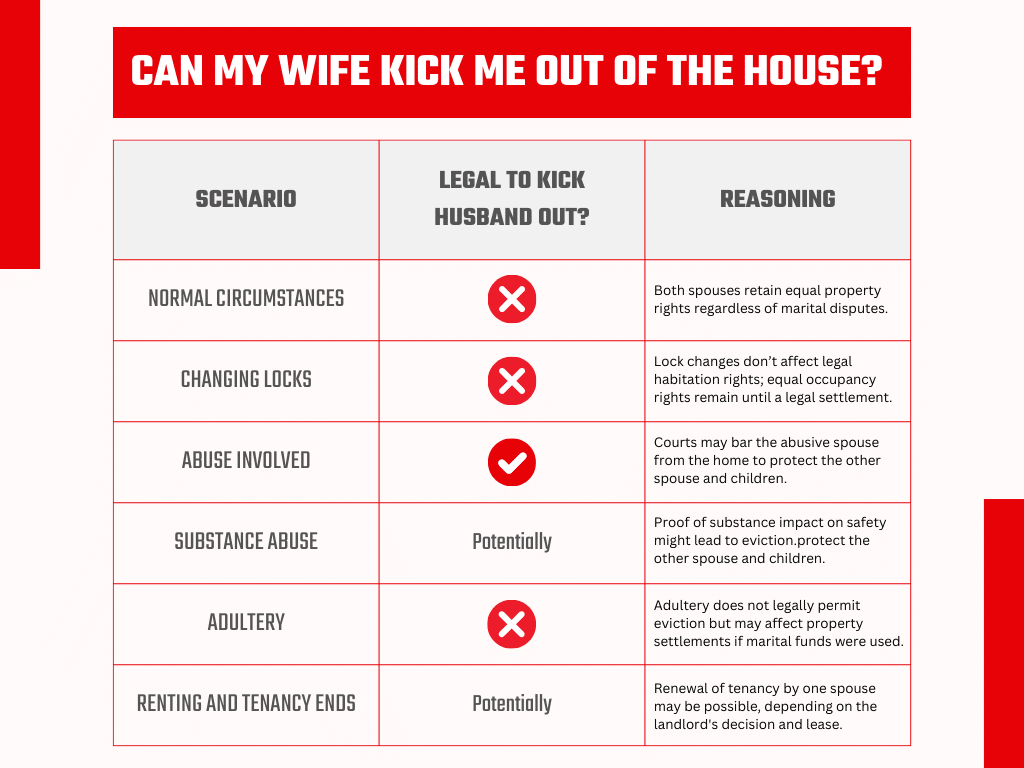
Whether your wife can legally remove you depends on the specific situation you’re in. The general rule (ownership doesn’t decide; only a court order can move you) holds, but the path she would take, and how fast it could go, changes with the facts. § 61.13 routes the answer one way when minor children are in the house; the noticed-motion process for exclusive use looks different from the ex parte path under § 741.30.
What to Do Before She Files Anything
Most of the work that protects a husband in this position happens before any court is involved. If things at home are tense and you can see this coming, do the following now, not after a deputy is at the door with paperwork.
- Document your residence. Pull together utility bills in your name, a lease or deed, mail addressed to you at the home, anything that establishes you live there. Keep copies somewhere outside the house.
- Don’t change the locks. Don’t remove her belongings. Anything that looks like a unilateral lockout or retaliatory move is the same mistake you don’t want her making, and judges remember it.
- Don’t engage in arguments that can be recorded or characterized later. If she’s documenting interactions, every yelled sentence becomes potential trial evidence. Walk away. Drive somewhere. Call your lawyer.
- Talk to a family lawyer before any altercation, not after. The hardest cases to defend are the ones where the husband first calls a lawyer the morning after a 911 call.
- Know what an injunction looks like before you’re served with one. Read Form 12.980(a). If you understand what she would have to allege and what the temporary order would prohibit, you’ll respond faster and smarter when something arrives.
How This Plays Out in Hillsborough and Pinellas
Most of the husbands we represent are in the 13th Judicial Circuit (Hillsborough County, Tampa) or the 6th Judicial Circuit (Pinellas County, St. Petersburg). The statutes are the same statewide, but how fast a hearing gets calendared, how a particular division handles temporary motions, and how a circuit’s clerks process injunction petitions all vary by county. A lawyer who appears in those courthouses every week reads them differently than one who doesn’t.

 Tampa's Family Lawyer For Men